Housed in a robust enclosure and targeting a 40 × 40 mm footprint, it delivers reliable detection up to 200 meters.
Engineered for industrial deployment, it operates from -45°C to 80°C, supports a wide 5–60 V input with integrated protection, and consumes up to 8 W.
Flexible interfacing via USB, UART, and 100BASE-T, along with Molex PicoClasp and Samtec connectors, makes integration straightforward for embedded and networked sensing applications.
A Rugged Radar Sensing Node
The module outputs ethernet, USB and CAN on Molex PicoClasp headers as well as a stacking header. This gives huge flexibility in terms of integration, allowing the module to be cable mate or board mate.
Put simply, this module is designed to be a rugged radar sensing node, requiring zero integration work to deploy on a rugged, SWaP limited system.
Key Specifications
- Range: 200 meters
- Azimuth angle resolution: 10°
- Altitude angle resolution: 30°
- Azimuth FOV: 80°
- Altitude FOV: 24°
- Dimensions: 40mm x 40mm x 16mm
- Communication buses: 100BASE-T, USB 2.0, CAN
- Connectors: Molex PicoClasp, USB-C, Samtec ERM stacking header
Why Engineers Are Switching to mmWave Radar

- Works in fog, rain, dust, smoke
- Detects range, velocity, and angle simultaneously
- Operates independent of lighting conditions
Built for Real-World Autonomous Systems
Use Cases
UAS Radar & Drone Detection
- Detect and track drones in real-time
- Suitable for perimeter security and airspace monitoring
Robotics Navigation
- Obstacle detection + velocity estimation
Sensor Fusion (Radar + EO/IR)
- Radar fills gaps where cameras fail
- Improves detection reliability in harsh environments
Ground & Aerial Tracking
- Continuous tracking independent of visibility
- Works in complex terrain and environments
Designed for Engineers Who Don’t Want to Build Radar From Scratch
Why This Isn’t Another Radar Evaluation Kit
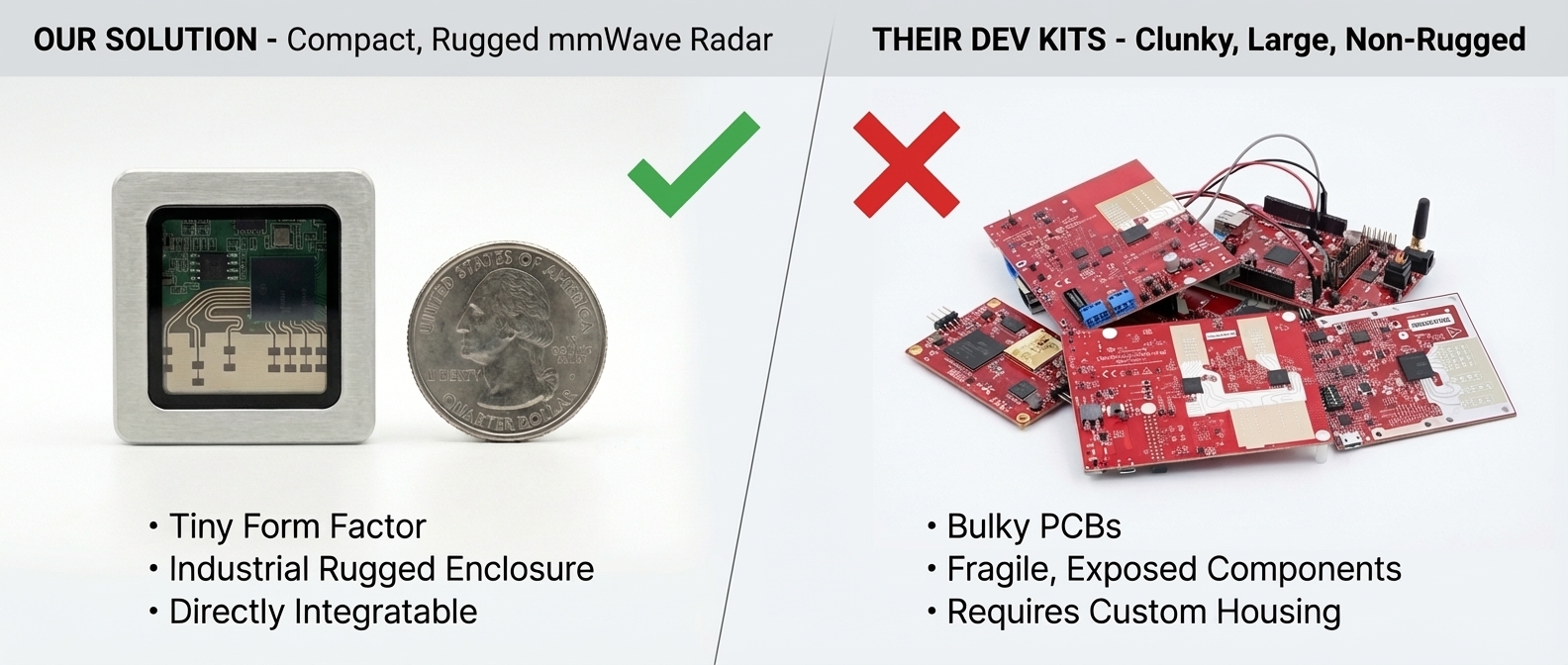
- No RF tuning required
- No antenna design
- No signal processing expertise needed
- No fragile dev kits
- Super compact, and tested for harsh environments
- Easy connectivity with USB/Ethernet or stacking header
mmWave Core abstracts the complexity of radar into a deployable module.
FAQ
What is mmWave radar used for in drones?
- Used for detection, tracking, and navigation in environments where vision fails.
Does mmWave radar work in fog or darkness?
- Yes, it operates independently of lighting and performs well in adverse weather.
Is mmWave radar better than LiDAR?
- Not better, complementary. Radar adds robustness where LiDAR and cameras fail.
Do I need RF experience to use this?
- No, this module is designed as a plug-and-play radar system providing range, angle and speed data in digital format.
How is mmWave radar different from LiDAR and cameras in robotics?
- mmWave radar complements cameras and LiDAR rather than replacing them.
- Cameras provide classification, and LiDAR provides high-resolution mapping, but both can fail in fog, dust, smoke, or low light.
- mmWave radar continues to operate in these conditions and provides reliable distance, velocity, and motion tracking, making it essential for robust autonomous systems.
Can this radar detect and track small or fast-moving drones?
Yes. mmWave radar is well-suited for detecting small aerial targets, including drones, because it measures both range and velocity directly.
This allows it to track fast-moving or low-visibility objects that may be difficult for vision-based systems to detect consistently.
What do I need to get started with mmWave Core?
Very little. The module is designed to be plug-and-play:
- Provide power
- Connect via the supported interface (e.g., UART / Ethernet)
- Start receiving detection data
No RF design, antenna tuning, or radar signal processing expertise is required, which significantly reduces development time compared to traditional radar solutions.
Simulation results
Coming soon.